
French organ cases 1691-1750 (2)
by Auke H. Vlagsma |Photo's: Christophe Coulot |Het ORGEL |Year 122 |(2026) |Issue 4| Categorie Organ building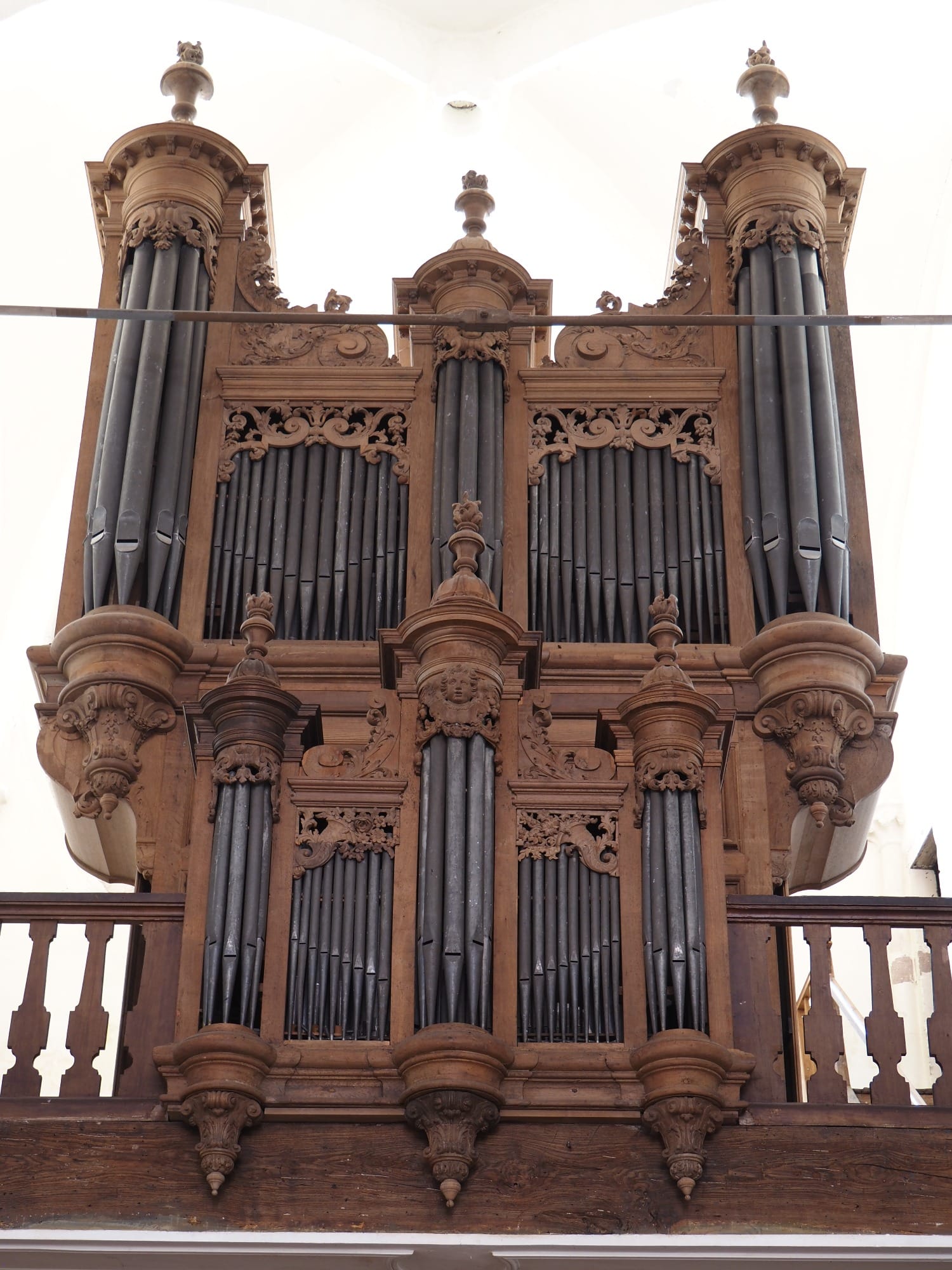
Organ in Seurre, Église Saint Martin, department of Côte-d’Or, region of Bourgogne-Franche-Comté, case 1699
Seurre is a small town in Burgundy, halfway between Dole to Beaume, where two branches of the Saône meet. The church was built in the Romanesque style in the late thirteenth or early fourteenth century.
The Parisian organ builder Julien Tribuot built the organ in 1698 and 1699 for the Cistercian abbey of Maizières (Saône-et-Loire). In 1791, the Lyon organ builder Bénigne Boillot installed it in Seurre, adapting it to the musical taste of the time. Julien Tribuot was an important organ builder who also worked with Robert Clicquot on the organ in the royal chapel of the Palace of Versailles for Louis XIV.
The maker of the cases is unknown. This is a typical example of an eight-foot Grand orgue with three semicircular towers, the central one being the smallest, and intervening flats containing pipes laid out in thirds. The arrangement is reversed in the Positif case on the gallery rail: the central tower is the largest, and the pipe mouths in the intervening flats form a line moving away from the central tower. The carvings are symmetrical and finely executed, with crisp lines. Beneath the outer towers is a curved transition with an acanthus-leaf pendant at the front. All the towers are surmounted by flaming urns, and masks are incorporated into the pipe shades of the central towers.